What Makes a Mining Pool Worth Staying In
Switching pools costs a day of downtime at the old one and a learning curve at the new one — at 1 PH/s, that day is roughly $40 of gross income at the readings of 22 Sept 2026. So the useful question is not which pool looks best on a review site, but which one you would still be using in six months. Four things answer that: how often you are paid, what you can audit, what leaving costs, and whether it still works when something breaks at 3 a.m.

Key takeaways
- Settlement cadence sets how usable the income is: hourly payment at 1 PH/s is 0.00001973 BTC, about $1.68, every hour of uptime.
- A full day at 1 PH/s is 0.00047353 BTC before the listed fee — roughly $40.39, or $38.77 once the listed 4% on the block-reward leg is taken off.
- Two statistics decide whether the dashboard is trustworthy: Pool Hashrate tells you how your share is moving, and Pool Luck tells you whether a quiet run is normal.
- A day of complete downtime at 1 PH/s costs about $40, which is the real price of an unnecessary migration.
The payment clock is the first reason to stay
Hourly settlement changes how a mining operation feels from the inside. Money stops being a monthly event and becomes a daily fact, which means an unpaid power invoice is a decision rather than an accident. At 1 PH/s the hourly rate is 0.00001973 BTC, about $1.68, and it lands 24 times a day at the difficulty in force at the time. Over 30 days that is 0.014206 BTC, near $1,211.68 before any fee is subtracted.
A rolling-window alternative distributes each block after confirmation over a defined set of recent difficulty rounds, with a lower listed rate on the combined components. The payout there is sometimes larger and never certain in its timing, and the miner accepts the pool's luck over the window as part of the deal. Neither arrangement is automatically better; what makes you stay is knowing which one your cash flow actually needs.
The distinction is sharpest in the numbers a small pool of hashrate produces. At 1 PH/s the difference between the listed 4% and the listed 2% on the block-reward component is $24.23 across a month. That is the entire annualised argument for one settlement mode over the other at this size, and it is small next to a week of avoidable downtime.
What you can audit every month
Staying put is easier when the numbers are checkable. Pool Hashrate shows the total hashrate the pool is applying, so you can see whether your proportion of it is rising or being diluted by other miners joining. Pool Luck compares the blocks the pool actually found against the number its hashrate implied over the same stretch, which is the statistic that explains a quiet night.
That explanation matters even on hourly settlement, where the pool absorbs the luck. If your own accepted hashrate is steady while the pool's luck dips, nothing is wrong with your site, and the correct action is no action. Without that reading, a slow spell on the chain looks like a hardware problem and gets chased with a screwdriver.
| Reason to stay | The number behind it | How to test it |
|---|---|---|
| Payout cadence | 0.00001973 BTC an hour, about $1.68 | Count payments in your own history over two weeks |
| Settlement mode | $24.23 a month between the listed 4% and 2% on the block-reward leg at 1 PH/s | Decide whether you want certainty or the window's upside |
| Visible statistics | Pool Hashrate and Pool Luck published continuously | Try to explain last week's dip without asking support |
| Monitoring | Real-time hashrate with alerts on mobile | Break something on purpose and time the alert |
| Exit cost | About $40 a day of gross income at 1 PH/s | Add migration downtime to any alternative you price |
Worked example: the first 24 hours at 1 PH/s
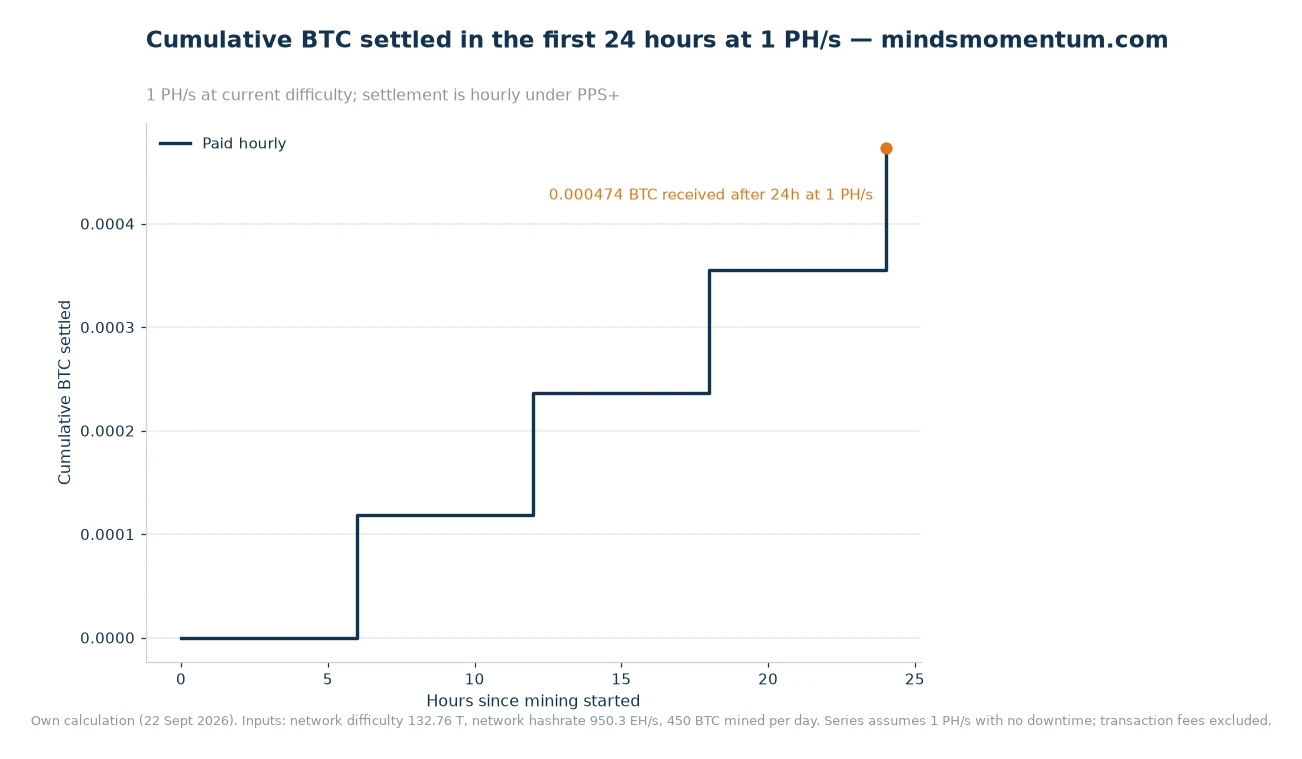
Take hourly settlement at the current difficulty and hashrate. One PH/s earns 0.00001973 BTC an hour, so an unbroken day accumulates in even steps: 0.00011838 BTC by hour six, 0.00023676 BTC by hour twelve, 0.00035515 BTC by hour eighteen and 0.00047353 BTC by hour twenty-four.
Convert the endpoint at $85,294 per BTC and the day is worth $40.39 gross. Apply the listed 4% to the block-reward share and roughly $38.77 of it survives, which is a little under $1.62 taken from the day. Multiply that out and the monthly figure matches the ledger arithmetic above — the same 0.014206 BTC, the same $1,211.68 before fees.
Now price the interruption. Every hour the machines are off costs 0.00001973 BTC, which is $1.68 at current prices. A failed power supply, a firmware update that goes wrong or a weekend migration all cost that same rate, which is why downtime — not the gap between two advertised fees — is usually the largest line item in a miner's month.
What leaving actually costs
Migration is the test most operators never run in advance. Re-pointing a fleet takes an afternoon and a day of lost income at 1 PH/s is about $40, before counting the time spent rechecking worker names, payout addresses and alerting. A pool that keeps you there is simply a pool where that calculation never looks attractive, and the mechanics behind it are visible: an account that pays hourly, publishes its own statistics, and holds the mined coin beside the rest of your ViaBTC Mining Pool balance so a payout is a bookkeeping entry rather than a transfer to organise.
Read the pool hashrate page for a week before you commit a fleet, and the listed mining pool fees before you commit a spreadsheet. Between them they tell you the two things that are hardest to change later: how your share is moving, and exactly which component of the reward each listed rate applies to.
Frequently asked questions
How often are PPS+ earnings paid?
Every hour, at the difficulty in force at the time. At 1 PH/s that is 0.00001973 BTC an hour and about 0.00047353 BTC across a full day before the listed fee is applied.
Why watch Pool Luck if the pool absorbs the luck?
Because it separates a normal quiet stretch from a fault. On hourly settlement the pool's luck does not change your payment, so any dip in your own numbers points at your hardware or your connection.
What does a day of downtime actually cost?
At 1 PH/s, about $1.68 for every hour off — roughly $40 across a full day at the difficulty and price read on 22 Sept 2026.
Run the exit test before you need it
Write down what you would lose by moving: one day of income, plus the hours of reconfiguration, plus whatever your alerts and records depend on. Then check that the pool you are in answers the four questions above with numbers rather than adjectives. Re-read the statistics monthly, because a share that is quietly shrinking is the most common reason miners leave and the easiest one to spot early. Keep the fee components written next to your payouts, and revisit the settlement mode whenever difficulty takes a step, since the gap between modes moves with it.
Data and sources: ViaBTC listed fee schedule[1] and the public pool statistics page, with network readings of 22 Sept 2026 — difficulty 132.76 T, next adjustment estimated +1.90%, implied network hashrate 950.3 EH/s, 450 BTC issued daily, BTC at $85,294 — read 22 Sept 2026. All figures are arithmetic on those inputs and are not a promise of earnings.