Two Kinds of Variance: What 347 TH/s Cannot Avoid
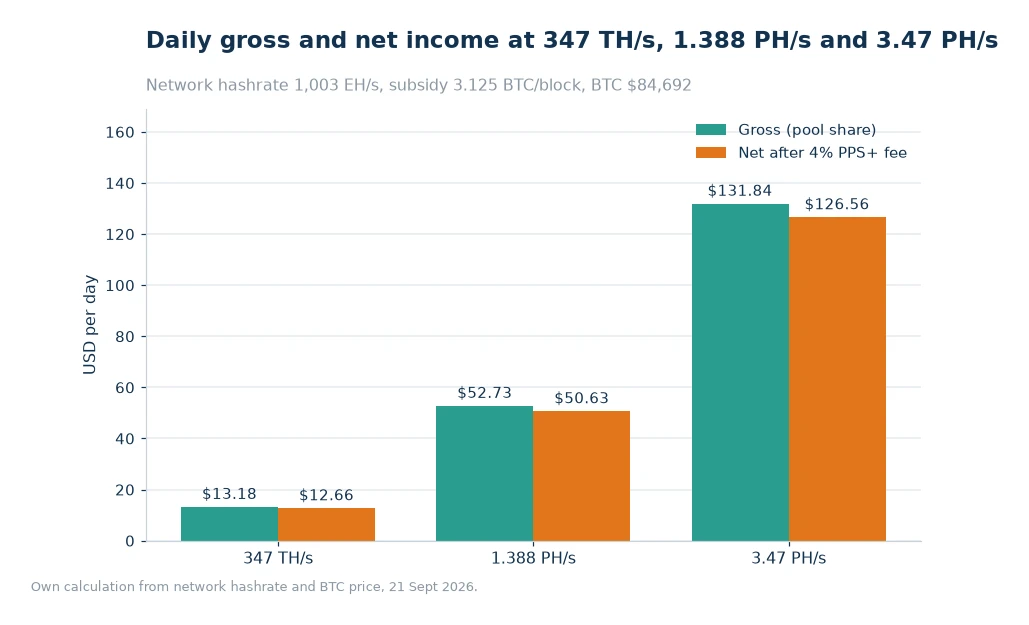
Some variation is a property of the network and some is a property of your building, and only the second is worth fixing. At 347 TH/s the pool credits 0.00015567 BTC a day, $13.18 at $84,692 per BTC and $12.66 after the listed 4% on the block-reward component. That figure assumes the machine runs all day, the difficulty holds and the price stays put; none of those assumptions is under the miner's control.

Key takeaways
- 347 TH/s credits 0.00015567 BTC a day, $13.18 gross and $12.66 after the listed 4% on the block-reward component.
- A 2.12% difficulty fall lifts the daily credit to about $12.93; a 3-hour outage removes $1.58.
- PPS+ settles hourly against current difficulty and carries block-timing risk at a listed 4%; PPLNS carries a listed 2% and leaves that risk with the miner.
- A month at 95% uptime averages $12.03 a day instead of $12.66, a shortfall of $18.90.
Two kinds of variation
The first kind is shared. Network hashrate, difficulty and the BTC price move for everyone, and no payout method changes them. When difficulty rises, every machine on every pool earns less per terahash in the same proportion. When the price falls, every dollar figure falls with it. A miner can hedge or accept this, but cannot optimize it away by choosing a pool.
The second kind is local. A fan fails, a firmware update goes wrong, a breaker trips, a room overheats in July. These events are invisible to the network and entirely visible in your credit history, and they are the only variance a miner can actually reduce. It is worth separating the two because the fixes are different: the shared kind is managed with expectations and buffers, the local kind with maintenance and monitoring.
What the pool absorbs and what it does not
PPS+ settles the block-reward component hourly against current difficulty. That removes the timing of block discovery from the miner's balance: the pool pays for shares whether or not a block arrives in the next ten minutes. The pool carries that risk, along with orphan-block risk, and the listed 4% on the block-reward component is the price of the transfer. It does not make the credit fixed forever; it makes the credit smooth within a difficulty period.
PPLNS does not transfer that risk. The block reward and the transaction fees are shared under a listed 2% once a block is confirmed six times, and each miner's slice is measured over the last 5 difficulty rounds. On average this can pay more than PPS+, because the lower listed rate applies to the combined total, but the path is uneven. A miner on PPLNS needs a balance sheet that can absorb a quiet fortnight without selling coins to cover a bill.
Measuring your own variance
The ViaBTC Crypto Mining account keeps the history needed to separate local variance from shared variance. Take the baseline of $12.66 a day at 347 TH/s, then count the days that came in below 95% of it. If the count is one or two a month and each gap has an explanation, the local variance is under control. If the count is eight and none of them has an explanation, the problem is the site rather than the market.
The same history shows whether a change actually helped. Replacing a fan, moving a rack away from a sunny wall or adding an intake vent should show up as fewer low days in the following month. Without a baseline and a count, those improvements are opinions. With them, they are measurable, and the next maintenance decision can be made on the same basis as the last one.
Four scenarios, one hashrate
The table changes one assumption at a time from the base case, so the size of each effect is visible. The outage and uptime rows are local; the difficulty row is shared; the base row is the arithmetic everything else is measured against.
| Scenario | BTC per day | USD per day | Change |
|---|---|---|---|
| Base case | 0.00014944 | $12.66 | none |
| Difficulty minus 2.12% | 0.00015269 | $12.93 | plus $0.27 |
| Three hours offline | 0.00013076 | $11.08 | minus $1.58 |
| Month at 95% uptime | 0.00014197 | $12.03 | minus $0.63 |
The difficulty row is the one that surprises people in both directions. A 2.12% fall is worth only 27 cents a day at this hashrate, while a single three-hour outage costs six times as much. That ratio is the argument for spending attention on uptime before spending it on forecasts: the local events are smaller in probability but much larger in effect at this scale.
Worked example
Take the base case, then apply each change in turn.
- Per terahash: 450 BTC a day divided by 1,003,107,267,295 GH/s is 0.00000044861 BTC.
- 347 TH/s: 347 multiplied by 0.00000044861 is 0.00015567 BTC, or $13.18 at $84,692.
- Listed 4%: 0.00015567 multiplied by 0.96 is 0.00014944 BTC, or $12.66.
- Difficulty fall: 0.00015567 multiplied by 1.0217 is 0.00015905 BTC gross, and 0.00015905 multiplied by 0.96 is 0.00015269 BTC, or $12.93.
- Hourly credit: 0.00014944 divided by 24 is 0.00000623 BTC, or $0.53.
- Three hours offline: 3 multiplied by 0.00000623 is 0.00001868 BTC, or $1.58, leaving $11.08 for the day.
- Ninety-five percent uptime: 0.95 multiplied by 0.00014944 is 0.00014197 BTC, or $12.03 a day.
Buffers, not predictions
A buffer is the cheapest response to variance because it does not require knowing which kind will arrive. Two weeks of power cost in reserve covers a bad fortnight without forcing a sale, and the size is easy to compute from the meter rather than from a forecast. A miner on PPLNS should size the buffer larger than a miner on PPS+, because the settlement path is wider, and a miner with a single machine should size it larger again, since one outage is a larger share of a small total.
None of this removes the shared variance. A difficulty rise or a price fall still changes the arithmetic, and the reading of minus 2.12% is an estimate rather than a commitment. What the buffer and the baseline buy is time: enough of it to react to a change instead of being forced to act at the worst moment, which is usually the difference between a manageable month and a bad one.
Review the buffer once a difficulty period rather than once a year. Two weeks of power cost was a sensible starting size when the machine was new; after a difficulty rise it may cover less than ten days, and the correction is a transfer rather than a decision. Small, regular adjustments keep the reserve matched to the risk, and they cost nothing except the habit of looking.
Frequently asked questions
Does PPS+ remove all variance from mining?
No. It removes the timing of block discovery from the balance and settles hourly at a listed 4% on the block-reward component, while difficulty, price and your own uptime still move the daily figure.
How much does a difficulty change matter at 347 TH/s?
A 2.12% fall lifts the net credit from $12.66 to about $12.93 a day, or 27 cents, which is smaller than the $1.58 lost to a single three-hour outage.
How big should a mining buffer be?
Start with two weeks of power cost, add more if you mine under PPLNS where settlement is uneven, and add more again if a single machine's outage is a large share of total output.
Decide who carries the variance
The payout method is a choice about who absorbs block timing, and the buffer is a choice about how much of it you can hold. Everything else is arithmetic that repeats every difficulty period. The pool state page shows how block discovery has actually gone, which is the evidence a PPLNS miner needs, and the fee schedule sets the two listed rates that price the transfer.
Sources: the ViaBTC homepage for payout terms and the fee page for the listed 4% and 2% rates[1]. Chain inputs read 21 Sept 2026: network hashrate 1,003 EH/s, difficulty 132.76 T, subsidy 3.125 BTC per block, 144 blocks a day, BTC $84,692, next difficulty estimate minus 2.12%. Published 22 Oct 2026. Scenario figures are arithmetic on those inputs and assume the stated uptime.